PART 49 of 52 ONESHOTS in 52 WEEKS
水菰厚司の『Where On When』 “Where On When” by MIKOMO Koji
Since its inception in 1986, Kodansha’s Afternoon magazine has been host to a newcomer manga contest titled the Afternoon Four Seasons Award. Given out four times a year, entrants vie for the Grand Prize, Special Jury Award, and Four Seasons ‘Shiki-sho’ Prize, by submitting oneshots and short manga. Past winners have included Nihei Tsutomu, Hiroaki Samura, and Yuki Urushibara, whose oneshots led to the publication of BLAME, Blade of the Immortal, and Mushishi respectively. The contest has also featured early work from the likes of Daisuke Igarashi, Hiroki Endo, and Haruko Ichikawa.
The contest is held in high regard, with many winners going on the establish a career in manga. Yet for some, the vocation is much more fleeting. An author named Koji Mikomo burst onto the scene in 1995 with a sci-fi oneshot titled Beyond, which received an honourable mention in the Four Seasons Award and publication in Afternoon. Two years later, the author submitted to the contest again with a stunning work titled Where On When, which went on to receive the Special Jury Prize, and was published in Afternoon in 1998. Tantalisingly, despite two industry-recognised short manga, this would be Koji Mikomo’s last appearance in the magazine, with little known about the author.
Where On When is set in a city surrounded by mountains on one side and an enormous steampunk-esque factory on the other. Nestled within the dense metropolis is Hiroko, a girl who has just turned sixteen. This affords her new freedoms, including access to formerly off-limits areas of the city and permission to go outside at night, though she would much rather focus on her passion for rhabdomancy. Roaming the streets, Hiroko uses the divination technique in search of meaning.
The plot is fairly unspecific, in that there is no obvious conflict or clear-cut interpretation. It is largely visually guided where, like Hiroko, readers will need to find meaning through observation and inference. The reserved Hiroko buries herself in a rhabdomancy book, which speaks of searching for minerals to find peace of mind, and describes techniques to retrieve something lost. With the encroachment of adulthood, Hiroko seems desperate to grasp at some divine meaning, looking for guidance or courage to find her place in the world.
Following her home-made dowsing instrument, Hiroko ventures to the enormous factory overlooking the city. Drawn to a shining object, she climbs to the building’s peak, only to discover a shard of glass. She scans her surroundings and is met by the staggering view from high above the metropolis, revealing a breathtaking scale as-yet-unseen to the young girl. Clearly astonished, Hiroko takes in the sight before returning home.
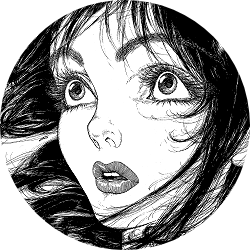
Whether Hiroko discovers her raison d’etre or is struck with uncertainty by the almost incomprehensibly large landscape is left unclear, but her stunned reaction, illustrated in full-page close-up, is an incredible piece of art. The equivocal plot works well in tandem with Koji Mikomo’s wonderfully detailed and atmospheric illustrations, with brooding visuals that well up emotions more so than any words might, encapsulating the perceptive feeling between adolescence and adulthood with a moody and mystical ambiance.
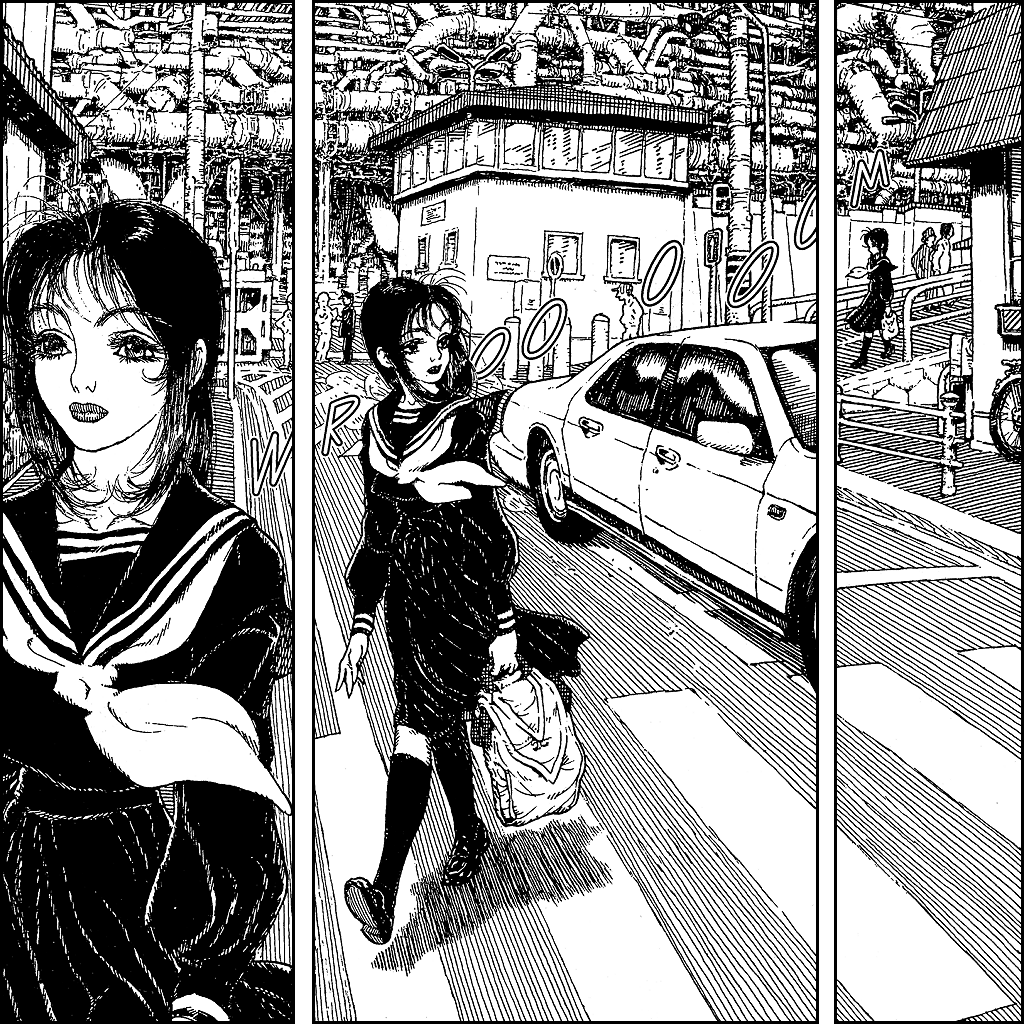
For an early work, the author’s style is already distinctive and individual. There’s a shoujo guise to Hiroko—particularly in the face—but the vivid linework and grainy backgrounds are more seinen. The art is chock-full of intricate character and complexion; the colossal factory is alive with bulging veins of pipework, the cityscape in its vastness sprawls into indistinction, Hiroko beams with wide eyes and feathery eyelashes, an urban night scene is dramatic in its gloom, lit sparingly by the piercing glow of streetlamps, and in interior scenes, exterior details are attentively illustrated through windows. Much of the pleasure of Where On When is in the art and the astounding composition of it all, with a lot of dynamism also present in the panel arrangement. In the image above, for example, a full-page spread is spliced into panels, with Hiroko moving through the scene.
Beyond, the author’s preceding oneshot about a group of researchers on Mars who share ominous dreams, also contains some brilliant illustrations, though overall it is a much rougher and less distinct piece, and polar opposite to Where On When with an overabundance of exposition. Koji Mikomo certainly displays a more commendable and refined approach with his folllow-up Where On When, which is executed with remarkable finesse across 35 pages. It’s surprising that such a striking and early work would be his last, with the author seemingly never releasing any further manga.
Click here to explore the rest of 52 Oneshots in 52 Weeks and find my numerical ratings on MyAnimeList!
 Morning, Roo