PART 51 of 52 ONESHOTS in 52 WEEKS
遠藤浩輝の『カラスと少女とヤクザ』 “Karasu to Shoujo to Yakuza” by ENDO Hiroki
Hiroki Endo is an author renowned for his catalogue of seinen manga, who quickly established himself as an interesting new talent in 1995, with successive winners of the Afternoon Four Season’s Award. The author’s early works, which typically navigate complex themes through a lens of violence and sexuality, would lay the groundwork for his first serial, Eden: It’s an Endless world, which is reputed for its philosophical complexions as much as its meticulous artwork.
This week, I’ll be looking at the author’s debut, The Crows, the Girl and the Yakuza. The 86-page manga, in which a homeless girl helps shelter an injured gangster, was published in Monthly Afternoon in 1996, after winning the Four Season’s Prize several months earlier.
Aoki is a chief member in a yakuza organisation, who finds himself a target when his affiliate Kanamori makes a move for power. Wounded and forced to flee, Aoki finds himself in the care of an unnamed girl, who resides in an abandoned warehouse with a family of outcast crows. As the girl nurses Aoki back to health, a duo of detectives and Aoki’s former comrade Kanamori start to close in on his location.
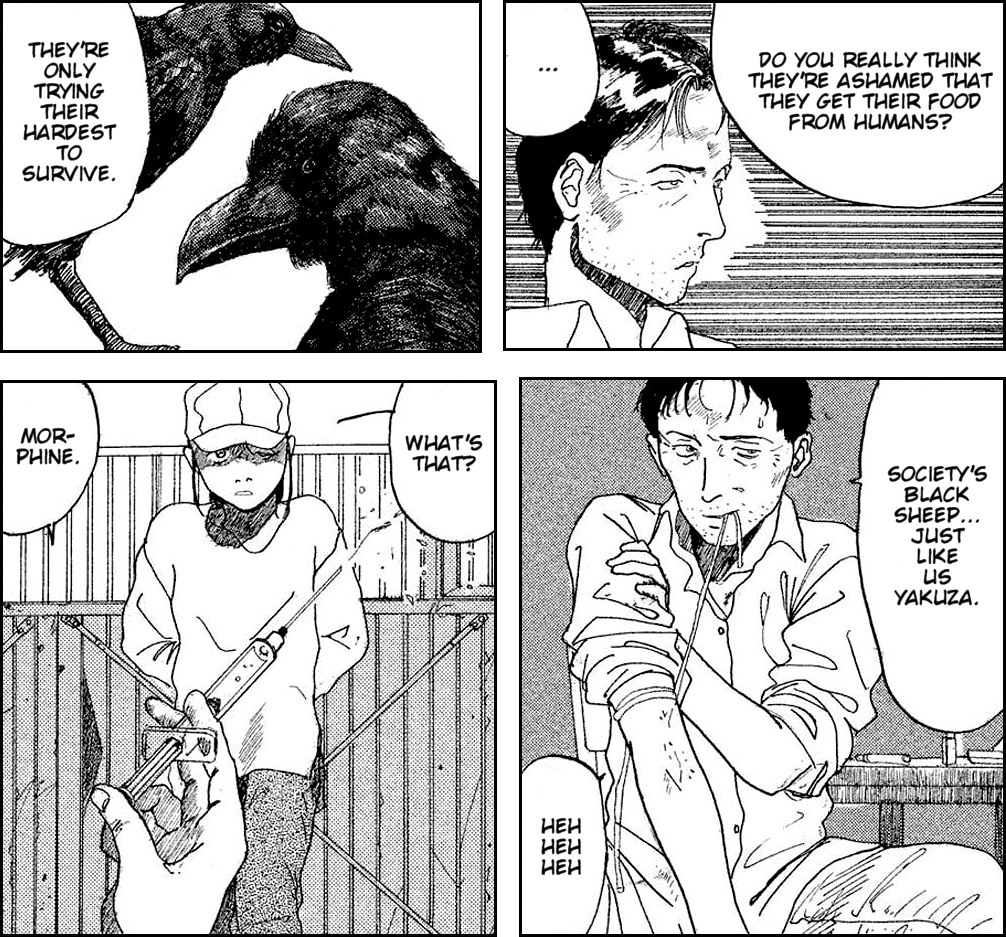
Gangsters and the yakuza are a popular subject in Japanese media, but Endo’s short tale is well distinguished. He adheres to the writing doctrine of ‘start late, finish early’ by beginning his story well after the inciting conflict. Details are tactically revealed in paced flashbacks, slowly but steadily characterising Aoki, whose brush with death has forced him to rethink his life and look back to a defining moment of his childhood.
The character is a bit of a stray in his adolescence, without friends or much of a home life. He see’s himself reflected in an injured bird, which he nurses back to health, only for the bird to promptly meet its fate to a ravenous crow. Pushed to despair, Aoki meets violence with violence and suppresses his vulnerabilities. The ‘Mother of Crows,’ as Aoki comes to affectionally refer to the homeless girl, becomes somewhat a surrogate mother figure to him, drawing out the boy within the man. Ultimately, the respective stories of the crows, the girl, and the yakuza—as the manga is so aptly named—come together to form a very gratifying whole. The author also takes some inspiration from the Greek myth of Apollo, Coronis and the raven; using it to contextualise and frame certain characters.
Hiroki Endo typically uses tone to denote shade and texture over ink or crosshatching techniques, which works well with his linework, which is technical and precise. His character art is also largely distinctive, and excels particularly in expression and gaze. Notable in the author’s debut are the warehouse interiors, with illustrations of stairways and ceiling beams which are impressive in their intricacy and exactness.
The Crows, the Girl and the Yakuza, along with five of the author’s other oneshots, was compiled into two Hiroki Endo ‘Tanpenshu’ volumes, released in 1998 and 2002 respectively, with English versions published by Dark Horse in 2007. These shorts form an absorbing anthology, with assorted depictions of knotty characters navigating a tumultuous existence. Hiroki Endo reliably infuses his work with impressive substance, whether that be through his studious research, articulate writing, or personal wisdoms, all of which is reflected here, though his recent manga reportedly hasn’t landed with the same impact.
Click here to explore the rest of 52 Oneshots in 52 Weeks and find my numerical ratings on MyAnimeList!
 Morning, Roo