PART 52 of 52 ONESHOTS in 52 WEEKS
ボウイチの『ホテル』 “Hotel” by Boichi
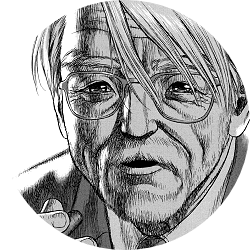
It seemed fitting that, for the final entry of 52 Oneshots in 52 Weeks, I revisit Hotel, one of the first short manga I ever read. The sci-fi odyssey by South Korean author Boichi was published in Weekly Morning in 2006, and serves as an updated version of a manhwa of the same name by Park Ji-hong, which found fame after winning a Creative Writing contest hosted by Dong-A University in 2004. The Boichi version was one of the first oneshots to make waves among English-speaking manga netizens, thanks to a quality fan translation in 2007. For many years thereafter, it reigned as both the highest rated and most read oneshot on MyAnimeList, until a technicality saw it removed from the list in 2011.
In the early twenty-first century, Earth is thrown into tumult due to the effects of climate change. Before conditions render the planet uninhabitable, an ark is constructed to ferry human DNA to a distant galaxy, while on Earth enormous towers are erected to preserve the DNA of all other living beings. The towers—colloquially known as hotels—are managed and tended by a robot known as Louis, who details his efforts to fulfil his solitary duty over the course of twenty-seven million years.
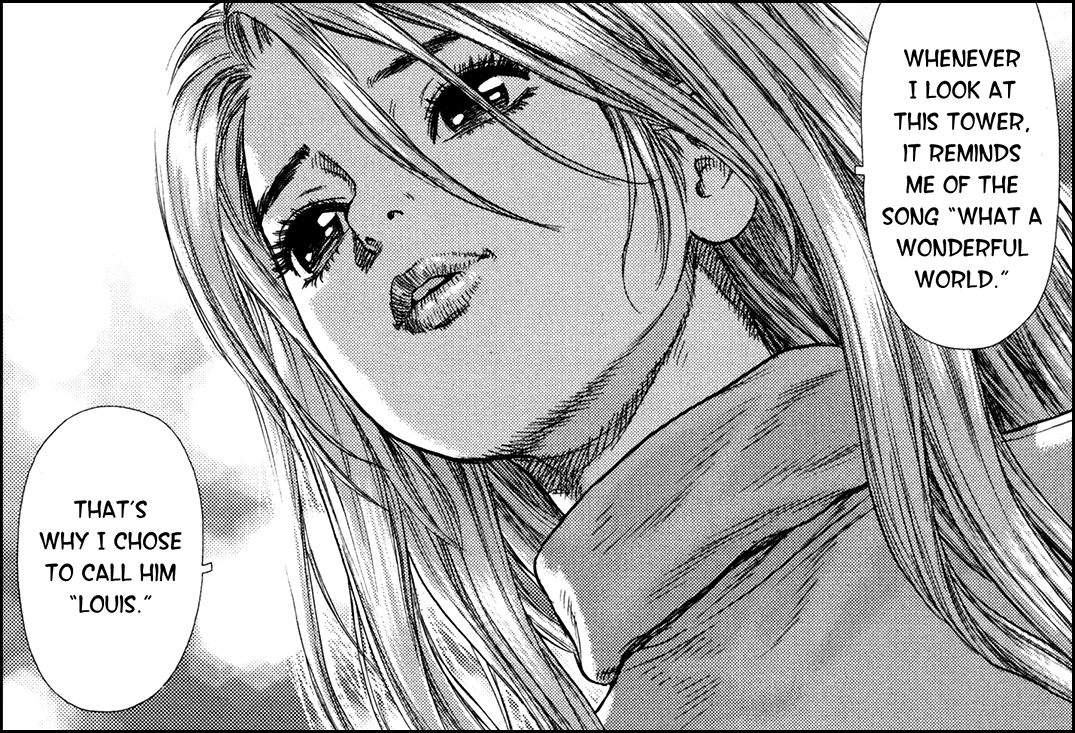
With an epic timeline and apocalypse theme, Hotel certainly delivers spectacle, with Boichi’s illustrations depicting a burdened planet in fittingly desolate fashion, but the manga’s foremost allure is in its enduring portrait of humanity, festered through the eyes of a devoted robot.
On the eve of destruction, chaos reigns, with many racked by desperation and guilt. Dr. Anno, the scientist who pioneered the towers, as well as its robotic caretaker Louis, declares that humankind doesn’t deserve to be saved, with no human DNA to be preserved on Earth. Indifferent to society’s furore is Louis, who observes innocently from the boundaries of his rigid programming. Yet as the years pile on, the robot gains a sentience of his own. He begins to ponder the futility of his task, but struggles onward, guided as much by a familial desire as by his directive.
Louis’ introspections are evoked well in a diary-like narrative which unravels in snapshots across thousands of millennia, culminating with the return of the ark’s mechanical ancestors. The lonesome Louis reveals that, in violation of his creator’s instruction, he has harboured a single sample of human DNA—his brother, as he affectionately refers to the vial—taken from his so-called parents. Ultimately, it is Louis’ acquired sentiment that gives hope to a new age of humanity, contrasted with the more uniform beings of the ark, who fail to preserve their samples.
Boichi’s artwork is just as imposing as the story’s immense timeline, with frenzied illustrations of rampaging weather and majestic compositions of future machinery. In the middle of the 42-page manga, as it transitions from the present toward the far future, a montage of panels depicts a tranquil Earth alongside lyrics to Louis Armstrong’s ‘What a Wonderful World,’ which is where the central robot gets his name. I can empathise that some readers may find this scene a bit eye-rolling, but I found it imbued the images with a cinematic quality, and elicits the pathos of the calm before the storm in a grounded and worldly fashion.
Hotel is a layered, reflective and, as ever, relevant tale, touching upon environmental issues, destiny and redemption, with discerning depictions of the poignant introspection of solitude. The 2004 Park Ji-hong version is also worth a look; it covers the same story beats as its follow-up, but the artwork is in full-colour like most manhwa, and the ending is slightly different, with future humans rather than future robots. The full title of Park Ji-hong’s oneshot is ‘Hotel: Since 2079,’ while Boichi opts for ‘Hotel: Since A.D. 2079.’
There was some slight controversy in 2006 following Boichi’s release of Hotel, with readers wondering whether the author had plagiarised Park Ji-hong’s earlier version of the story. As it turns out, Boichi was a prominent part of Park Ji-hong’s Hotel, providing the author with the original script and a storyboard. When this came to light, some commentators argued this should invalidate Park Ji-hong’s Creative Writing Award, which was given under the pretence that it was a solo work, rather than a collaboration, but the organisers were already aware of Boichi’s input and didn’t take any issue. In a bizarre twist, many English-language websites credit the authors the other way around, attributing the 2004 version of Hotel solely to Boichi and omitting Park Ji-hong entirely, despite him being responsible for all of the artwork.
The two author’s collaborated again in 2005 (this time with no hidden credits) on a manual title The Blueprint of Life, which explored scientific theories within a comic format. Before this, Park Ji-hong had several short spells in Anitech and the Korean version of Young Jump, while Boichi has since become known for series such as Sun-Ken Rock and Dr. Stone.
Click here to explore the rest of 52 Oneshots in 52 Weeks and find my numerical ratings on MyAnimeList!
 Morning, Roo