
A few months ago, the Shueisha-run platform MANGA Plus announced it would begin simulpublishing new oneshots in English as well as Japanese, focusing primarily on their Jump Plus catalogue, which has become renowned for its abundant library of short manga. For English-speaking manga fans, this opens the door to a fabulous variety of otherwise undiscovered short works, from authors both new and old. Last week’s addition saw the return of a familiar name, with Claymore author Norihiro Yagi debuting a new oneshot, after concluding his latest manga series last year.
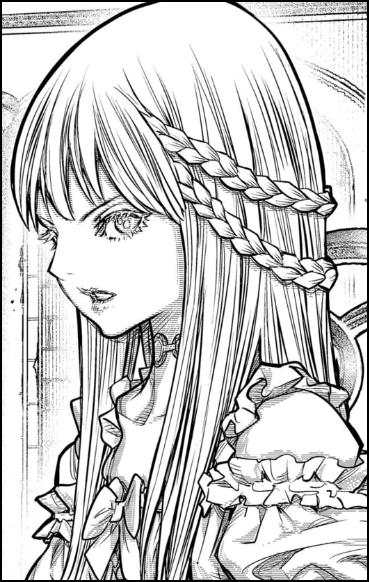
His new manga, titled The Knight and the Corpse, is set in a fantasy realm occupied by kingdoms. On his deathbed, the King of the powerful domain of Vishtark names his daughter Eleanor heir in favour of her brother, creating a rift between them. The brother aims to seize power before Eleanor’s coronation and sends mercenaries to capture her, but a newly met knight on the side of Eleanor proves a most powerful ally, who is able to unexpectedly rebuff attacks using divine magic. The noble knight is able to guide Eleanor to safety, leaving her with a seemingly decent entourage, but her brother’s machinations have already wormed their way into Eleanor’s inner circle, unbeknownst to her.
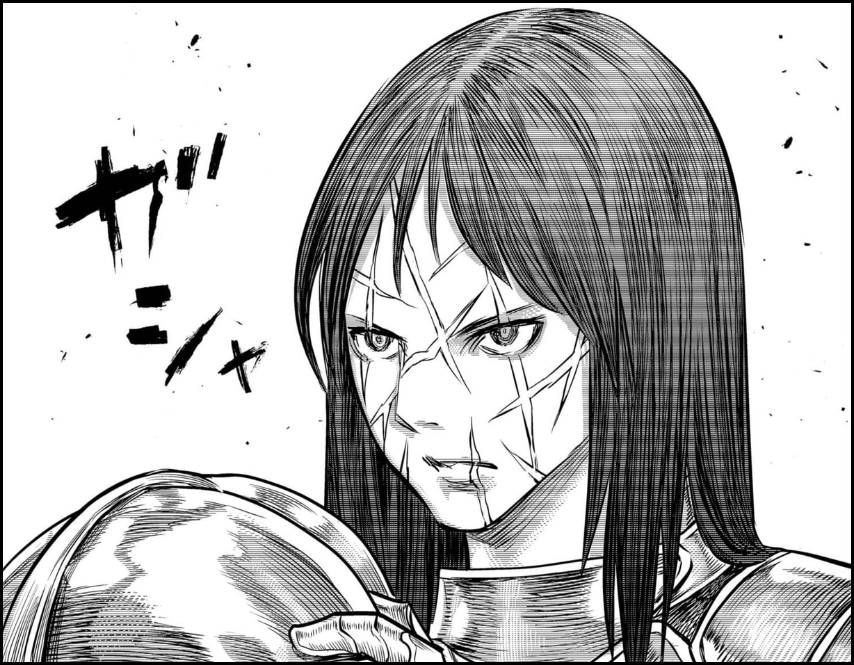
Norihiro Yagi is clearly very passionate about medieval fantasy, and captures a nugget of what made Claymore so compelling, with a layered setting and enticing magic system. Yet sadly The Knight and the Corpse suffers from many of the same problems as the author’s previous oneshot, Arcadia of the Moonlight, namely its nimiety of exposition. An ambitious tale of feuding kingdoms and fraught heirship unfolds, featuring an adversary turned vindicator, tipped with a coup d’état by armies who wage war with holy magic — it quickly becomes a bit too much for a 70-page manga, with a plot which is laboured by a constant stream of descriptions and information.
This is made all the more unwieldy by a poor translation, which manages to strip all the flavour and nuance out of the dialogue. For this new simulpub venture, Shueisha have teamed up with Orange Inc., who localise oneshots via their in-house workshop Studio Mikan. The company leverage AI in their translation work and the end result, even after it’s passed through a dedicated translation team, is nonetheless an awkward and erroneous text which is seriously lacking in character and in need of proof reading.
However, Norihiro Yagi’s ingenuity does occasionally peek through the murky clouds of cumber exposition and wooden dialogue. One of the oneshot’s most unique aspects is its magic system, where users known as ‘Divine Spirit Swordsmen’ can harness elemental forces to produce spells and enhance attacks. Its novelty resides in the fact that a person’s magic prowess is tied to fealty to their country and monarchy, where only those most devoted and noble are bestowed enormous power, establishing cultures of divinity magic. This is an absorbing concept, where the Vishtark kingdom bemusingly weakens its own magic fealty by refusing to recognise the rites of succession and staging a coup. Sadly, it fails to reach its potential in the confines of this story, where the magic ultimately boils down to spellcasters shouting moves at each other, with Norihiro Yagi mystifying the concept with enigmatic notions such as realm guardians and pre-eminent orders which, in this format, amounts only to shallow world-building. Its ideation here is gripping, but the broad and indefinite strokes can be frustrating.
The mysterious knight on the side of Eleanor is revealed to be a remnant of a conquered kingdom, the sole flame keeping the history of this past land burning. While their reticent ambiance and dominating presence is largely compelling, little of value is learned about this vagabond. They are identified as the “first knight of the guardian order” in an impressive page spread, but the title rings somewhat hollow for readers as it’s so devoid of context.
Some of the spells as rendered on the page are a touch mundane, existing as nondescript blasts of magic, though others are more enticing, with veined horses which are ‘spiritually enhanced’ to literally run as quickly as they can till their death, and a climatic showdown between lightning and fire, which is illustrated with an impressively dramatic flare. Norihiro Yagi’s artwork is recognisable and refined, presented here with some atmospheric colour pages which open the story. MANGA Plus allow readers to view the oneshot either vertically or horizontally, of which the latter is certainly preferable. Vertical splits the page spreads in half, spoiling both the artwork and flow.
Sadly, The Knight and the Corpse is far too clunky to appreciate as a stand-alone piece. It leans too heavily on narration and exposition, with the author overloading the reader by trying to fit an epic into a single chapter, producing a mechanical plot which races along without many stakes or any proper investment. As an already long-winded manga, the translation, which does a disservice in adequately communicating the author’s intent, only obfuscates details further, leaving the story as a somewhat ungainly affair. It’s exciting that so many new oneshots are now available to English-speaking regions, but equally a mighty shame that they are presented in such a shoddy and unprofessional manner. Hinderances notwithstanding, some elements do shine through, with Norihiro Yagi still ripe with novel twists and engaging concepts, which may better divulge themselves either in a more contained scenario, or in a work with more adequate length.
 Morning, Roo